Know What You Ship. Everywhere It Exists.
Build a complete, firmware-grounded Inventory across source, binaries, and supplier inputs, so decisions start from what actually ships.
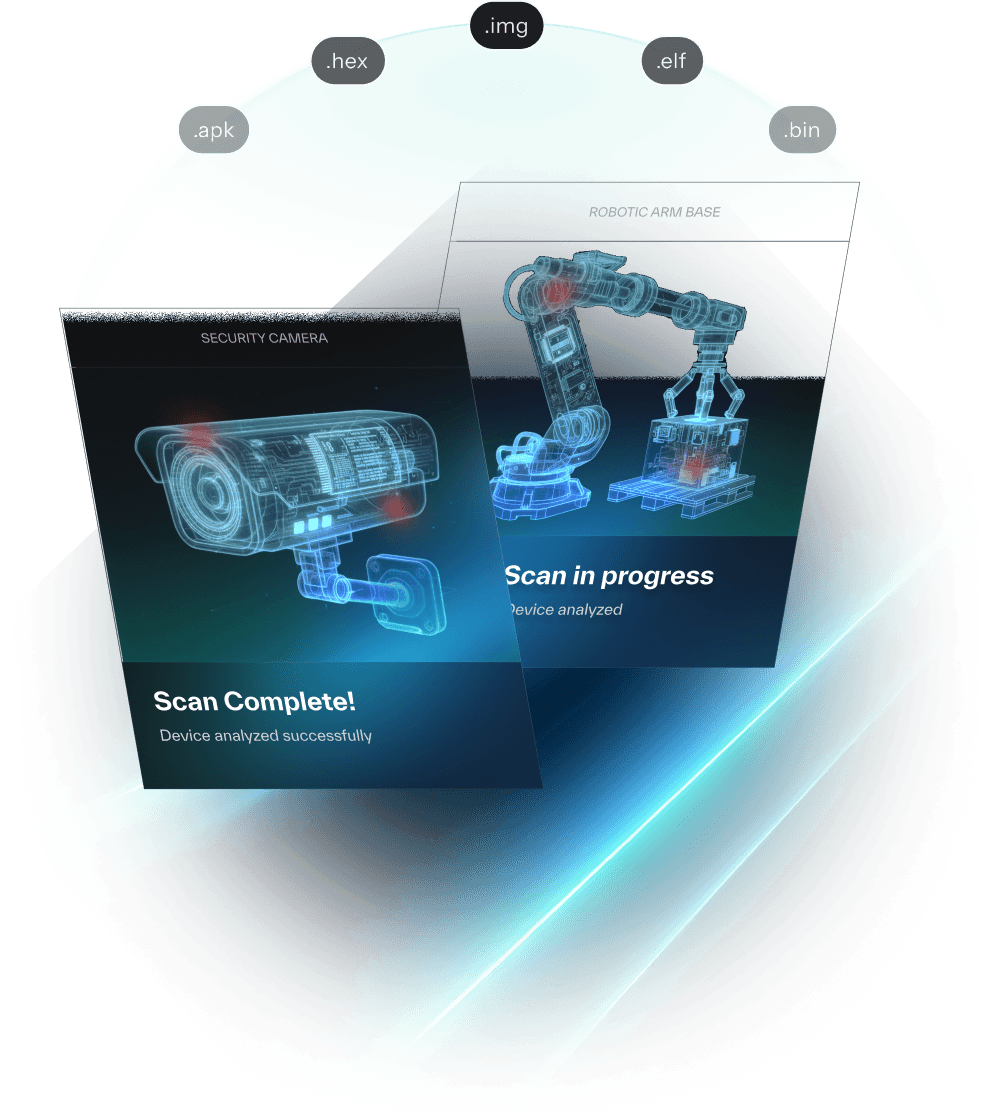
When Inventory Doesn’t Reflect Reality
Most organizations still rely on source-only scans, spreadsheets, or supplier attestations to understand their software. But shipped products include compiled binaries, firmware-only components, build-time additions, and reused code that never appears in source.
When inventory isn't grounded in shipped reality, SBOMs are unverifiable and security workflows start from assumptions.
Finite State builds a system of record for product software, anchored in firmware and reconciled with source and supplier data.
Instead of guessing what’s inside a product, teams work from a validated, continuously maintained view of what actually ships across releases and portfolios.
What Other Tools Miss
Most tools only see part of the picture, leaving blind spots that compound across releases. Finite State connects source, binaries, and evidence into a single system.
| FeatureFeature |   | Typical AppSec (source-only)Typical | Firmware-Only ScannersFirmware-Only |
|---|---|---|---|
Unified source and binary analysisUnified source and binary analysis | |||
Binary and firmware decompositionBinary and firmware decomposition | |||
SBOM generation and merge (source + binaries)SBOM generation and merge (source + binaries) | |||
Deduplication and correlation across buildsDeduplication and correlation across builds | |||
Reachability-based vulnerability analysisReachability-based vulnerability analysis | |||
Multi-source exploit intelligence enrichmentMulti-source exploit intelligence enrichment | |||
Policy checks and CI/CD gatesPolicy checks and CI/CD gates | |||
Audit-ready evidence packs (CRA, FDA, and others)Audit-ready evidence packs (CRA, FDA, and others) | |||
Post-market monitoring with living SBOMsPost-market monitoring with living SBOMs | |||
Developer workflows with PR-ready diffsDeveloper workflows with PR-ready diffs |
Impact Across the Lifecycle
Exploitability-Based Prioritization
Reachability and exploit analysis depend on the validated presence of components in firmware-grounded SBOMs.
Design-Time Architecture Security
Architecture assumptions and threat models can be reconciled against what actually ships, not just what was intended.
Automated Evidence-Backed Compliance
SBOMs and component inventories become reusable, evidence-backed artifacts across audits and releases.
Key Capabilities
Unified Binary, Firmware + Source Analysis
Perform unified analysis of firmware, binaries, containers, and source code to identify software components with high confidence. The Finite State Platform reconciles source and binary findings into a single view, eliminating blind spots caused by build-time inclusions or unused dependencies.
Direct analysis of compiled firmware images and executables
Correlation of binary findings with source repositories when available
Detection of components introduced during build or packaging
Identification of firmware-only and closed-source components
Consistent results across reruns and releases
Ground‑Truth SBOMs
SBOMs are generated from observed software artifacts rather than declarative manifests alone. Each component entry is backed by evidence from firmware, binaries, or source, forming the foundation for the Evidence Vault.
Firmware-derived component identification
Source enrichment for version and license accuracy
Evidence-backed validation of component presence
Living SBOMs maintained across product releases
Import/export support for industry-standard formats
Supplier SBOM Consolidation
Ingest supplier-provided SBOMs and scan outputs, normalize them, and reconcile claims against actual firmware content in one seamless workflow, powered by AgentOS.
Import supplier SBOMs in multiple formats
Normalize naming, versions, and metadata
Reconcile supplier claims with observed components
Track inherited risk across products and versions
Support supplier-specific reporting and review
Portfolio Inventory: The System of Record
Maintain all component, vulnerability, and decision data in a centralized, portfolio-wide system of record that persists across releases.
Portfolio-wide component and version tracking
Historical change tracking across builds
Centralized policy and status evaluation
System of record for SBOM, VEX, and audit data
API and integration support for downstream workflows
Finite State Platform Compatibility
Languages, architectures, operating systems, and binary formats analyzed to build ground-truth inventory.
Low-level systems programming languages
Memory-safe systems programming language
Enterprise-grade object-oriented language
High-level interpreted programming language
Dynamic web programming language
Concurrent systems programming language
Low-level machine code programming
Apple's modern programming language
Modern JVM-compatible language
Microsoft's object-oriented language
Server-side web scripting language
Dynamic object-oriented language
Text processing and system administration
Command-line scripting languages
Functional programming on the JVM
Google's client-optimized language
Typed superset of JavaScript
Apple's legacy programming language
Trusted by Product Security Teams
Proven results across automotive, industrial, medical, and consumer IoT.
Ready to Eliminate Blind Spots?
See how the most comprehensive device software coverage on the market gives you a unified, defensible view of what you ship across source, firmware, and binaries.