Respond to Vulnerabilities with Proof, Not Assumptions
Respond to new vulnerabilities with speed, accuracy, and proof. Quickly determine which products and builds are impacted, which are not, and produce customer-ready SBOM and VEX outputs backed by defensible evidence.
When a CVE Drops, Time and Trust Are on the Line
When a new vulnerability is disclosed, PSIRT teams are under immediate pressure to answer hard questions—often within hours:
- Are we affected?
- Which products, versions, and customers are impacted?
- What should we communicate, and how confident are we?
- Can we prove our decisions if challenged later?
Most teams struggle because:
- Vulnerability data isn’t mapped cleanly to products and shipped builds
- Impact analysis depends on manual correlation across tools and spreadsheets
- “Not affected” decisions are slow, inconsistent, or hard to justify
- SBOMs, VEX, and customer communications are assembled manually under deadline
The result is delayed responses, escalations, and unnecessary risk to customer trust and regulatory obligations.
Rapid vulnerability response requires ground truth, prioritization, and evidence that can be shared externally.
With Finite State, PSIRT teams move from new CVE to clear impact and customer-ready outputs in a single, continuous workflow—grounded in what actually ships and kept current as software evolves.
This workflow is enabled by:
- A firmware-grounded system of record for products, builds, and components
- AgentOS to analyze real exposure, apply structured prioritization logic, and maintain decision history
- Assurance Studio and Finite State Copilot to streamline review, validate findings, and generate external-ready communications
How It Works
Map New CVEs to Shipped Products and Builds
New vulnerability disclosures are evaluated against a ground-truth inventory of firmware, binaries, source code, and supplier components already mapped to specific products, versions, and builds.
What you get: Immediate visibility into which products and releases may be affected.
Determine Real Exposure Using Reachability
For each potentially impacted vulnerability, reachability analysis evaluates whether vulnerable code paths are actually reachable in the shipped builds, distinguishing theoretical presence from real exploit paths.
What you get: A fast, defensible answer to whether exposure is real.
Prioritize Using Exploit and Threat Context
Reachability results are enriched with exploit intelligence, severity, and internal response thresholds, so PSIRT teams prioritize vulnerabilities that combine real exposure with real-world risk.
What you get: Clear prioritization without subjective triage under pressure.
Record and Persist Impact Decisions
Affected and not-affected decisions are explicitly recorded with:
- Reachability rationale
- Standardized VEX status
- Full audit trail of who decided what, and when
Decisions persist across releases and can be re-validated as software changes.
What you get: Impact determinations that are repeatable, reviewable, and defensible.
Generate Customer-Ready Outputs
SBOMs, VEX documents, and supporting evidence are produced directly from the system of record and are:
- Consistent across products and releases
- Traceable back to shipped software and analysis
- Ready to share with customers, partners, and regulators
What you get: Faster, clearer communication with confidence.
Key Focus Areas
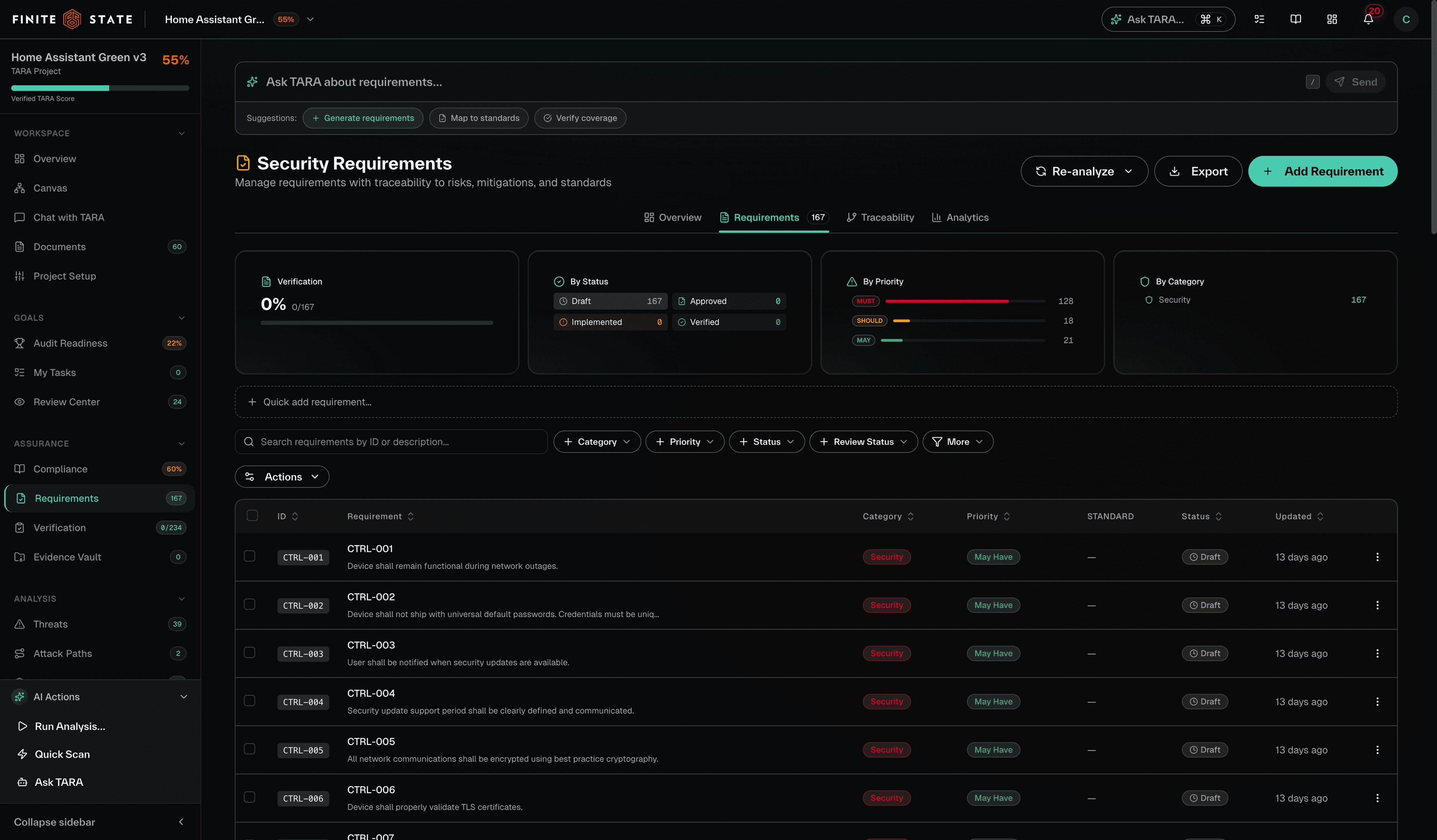
Rapidly establish scope when a vulnerability is disclosed. Impact analysis starts from shipped software and scales across portfolios and variants—eliminating manual correlation and early uncertainty.
- Impact: PSIRT teams establish scope quickly and confidently.
What This Enables
With a PSIRT workflow grounded in shipped software and automated evidence, teams can:
Respond to new vulnerabilities faster and with greater confidence
Reduce internal escalations and customer confusion
Communicate clearly which products are affected and why
Meet regulatory and contractual response expectations without last-minute scrambles
Most importantly, PSIRT becomes a repeatable, trusted process, not an emergency exercise.
The Log4j Wake-Up Call
When Log4j hit, teams scrambled for weeks across SBOMs, spreadsheets, and pols With Finite State, the same search takes minutes — with a unified, audit-re
MANUAL PROCESS
- Manual component inventory: 3-5 days
- Impact assessment: 1-2 weeks
- Patch coordination: 2-3 weeks
- Cross-team coordination & reporting: 3-5 days
AI-POWERED AUTOMATION
- Automated discovery: 2 minutes
- Impact assessment: 5 minutes
See PSIRT Response in Action
Move from CVE disclosure to defensible customer communication—fast.