The AI-Native Product Security OS for Connected Devices
Finite State unifies firmware, binaries, source code, and compliance evidence into autonomous, review-gated workflows that help engineering teams move at the speed of AI.




From Artifacts to Assurance
Product Security and Compliance, Automated
Not Assembled
The Finite State Product Security OS replaces manual evidence assembly with workflows that transform code, compiled components, firmware, and documentation into continuous security and compliance assurance.
Outputs stay tied to real product artifacts, so teams can secure every release, prove compliance continuously, and automate the work in between.
Regulators, customers, and release gates are converging on one technical demand: evidence that stays current with the software that ships.
Compliance is no longer a final documentation exercise. It is a release-by-release evidence requirement.
From Artifacts to Assurance
Product Security and Compliance, Automated
Not Assembled
The Finite State Product Security OS replaces manual evidence assembly with workflows that transform code, compiled components, firmware, and documentation into continuous security and compliance assurance.
Outputs stay tied to real product artifacts, so teams can secure every release, prove compliance continuously, and automate the work in between.
Regulators, customers, and release gates are converging on one technical demand: evidence that stays current with the software that ships.
Compliance is no longer a final documentation exercise. It is a release-by-release evidence requirement.
AI-native execution grounded in shipped software.
Traceable Workflow Automation
Across the Finite State Platform, Assurance Studio, AgentOS, and Finite State Copilot, teams move from firmware, binaries, source, and documentation to SBOMs, VEX, verification evidence, and audit-ready reports through a traceable, artifact-backed workflow.


Automated Compliance Tracking
That keeps security and compliance aligned to what actually ships, so teams can automate analysis and evidence generation without losing review, context, or proof.
System of record for shipped software.
Finite State Platform
Analyzes firmware, binaries, source code, supplier SBOMs, and third-party findings to generate SBOMs, vulnerability context, reachability insights, and a portfolio-wide record of product risk. Why it matters: Security decisions stay anchored in what actually ships.

CORE PLATFORM CAPABILITIES
From Shipped Software to Defensible Outcomes
The platform delivers this through connected capabilities that answer the questions behind every release:
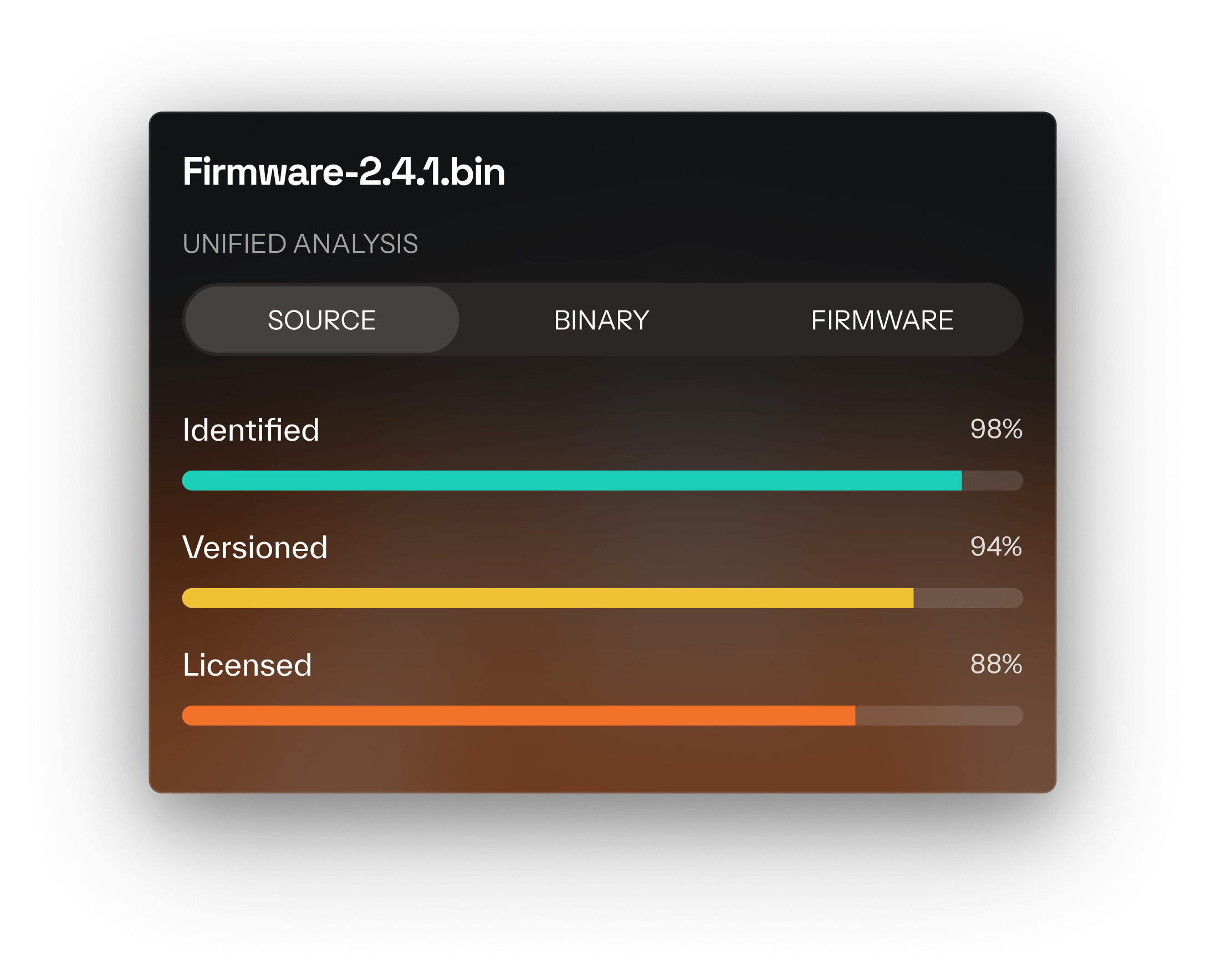
Ground Truth Software Inventory
Analyze firmware, binaries, source code, and supplier SBOMs to create a system of record for shipped software.
- SBOMs
- Component inventory
- Vulnerability context
- Portfolio visibility

Design Deployment Insights
What shipped, what matters, how design matches reality, and evidence proving decisions. Each capability creates outputs teams use.
Integrations out of the box
Unified Product Insights
Security, engineering, compliance, and product teams work from the same product evidence instead of reconciling separate tools and reports.
From Design Intent to Deployed Reality
Product security work breaks down when design docs, software analysis, verification, and compliance evidence live in separate tools. Finite State keeps them aligned as products change.
Ingest Product Artifacts
Bring firmware, binaries, source code, supplier SBOMs, and documentation into the platform.
Build the Shipped Software Record
Generate and maintain components, findings, releases, and product context.
Prioritize Real Exposure
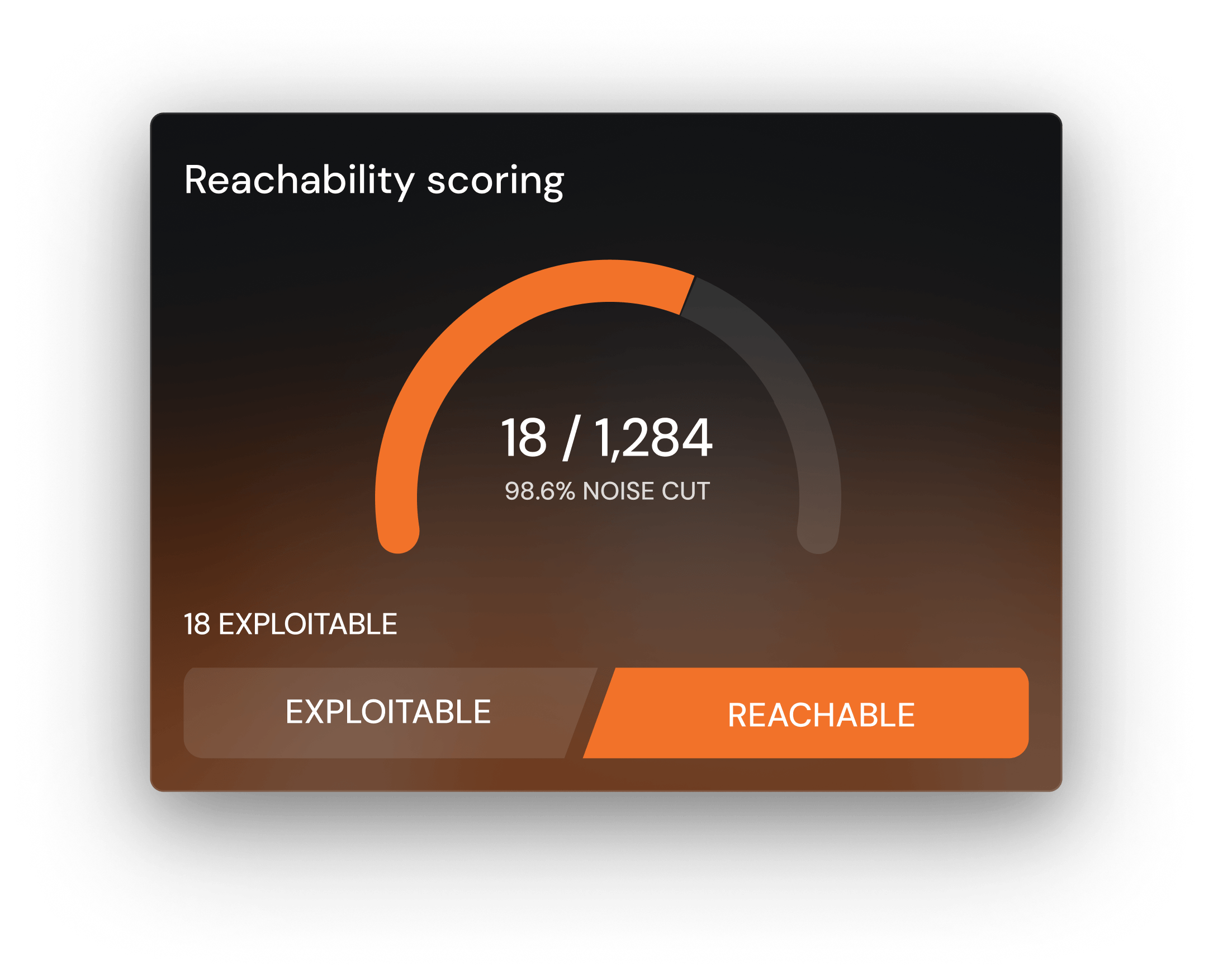
Use reachability, exploit intelligence, and product context to identify what actually matters.
Generate and Review Evidence
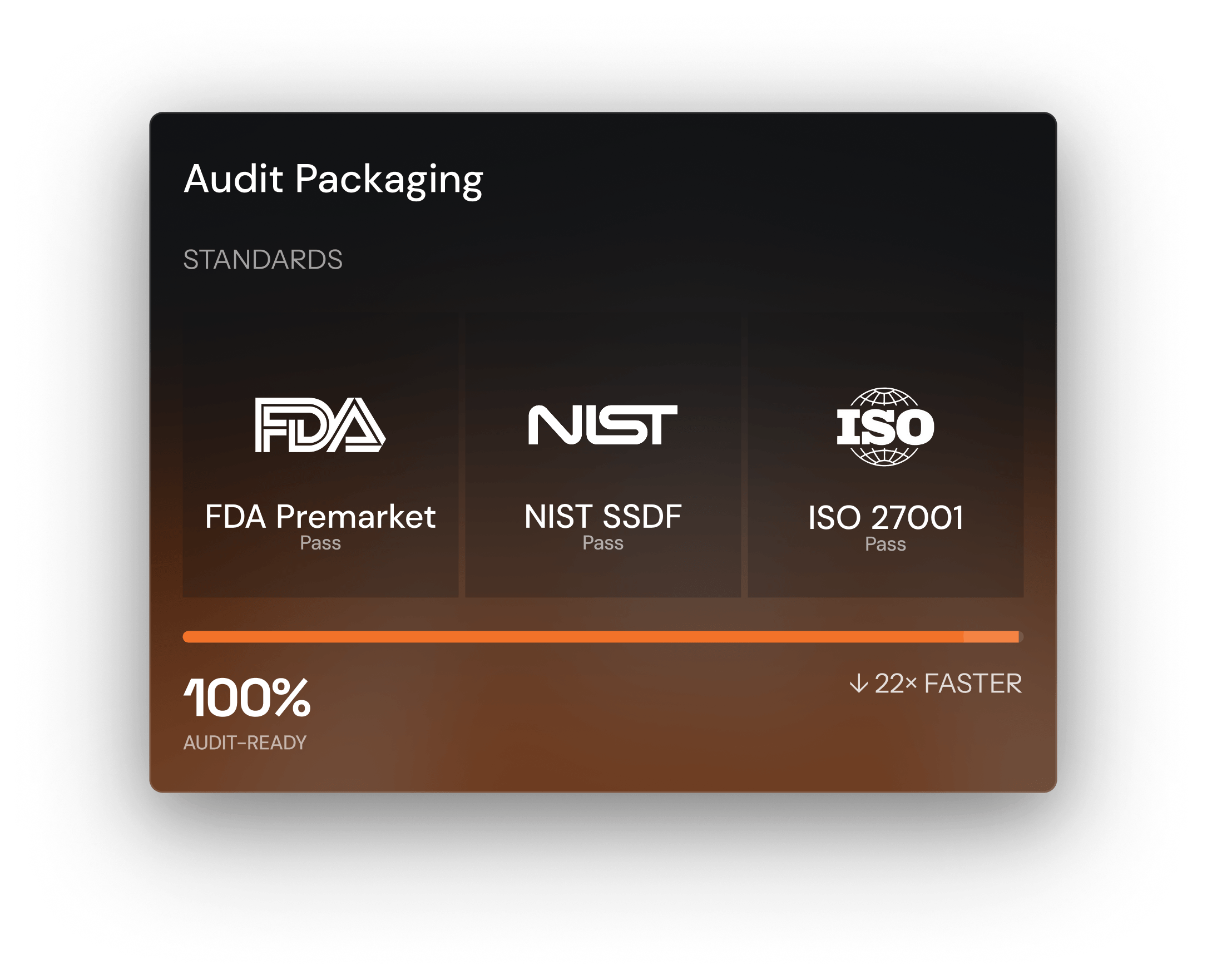
Create SBOMs, VEX support, verification records, control mappings, and audit-ready reports.
Monitor and Prove Continuously
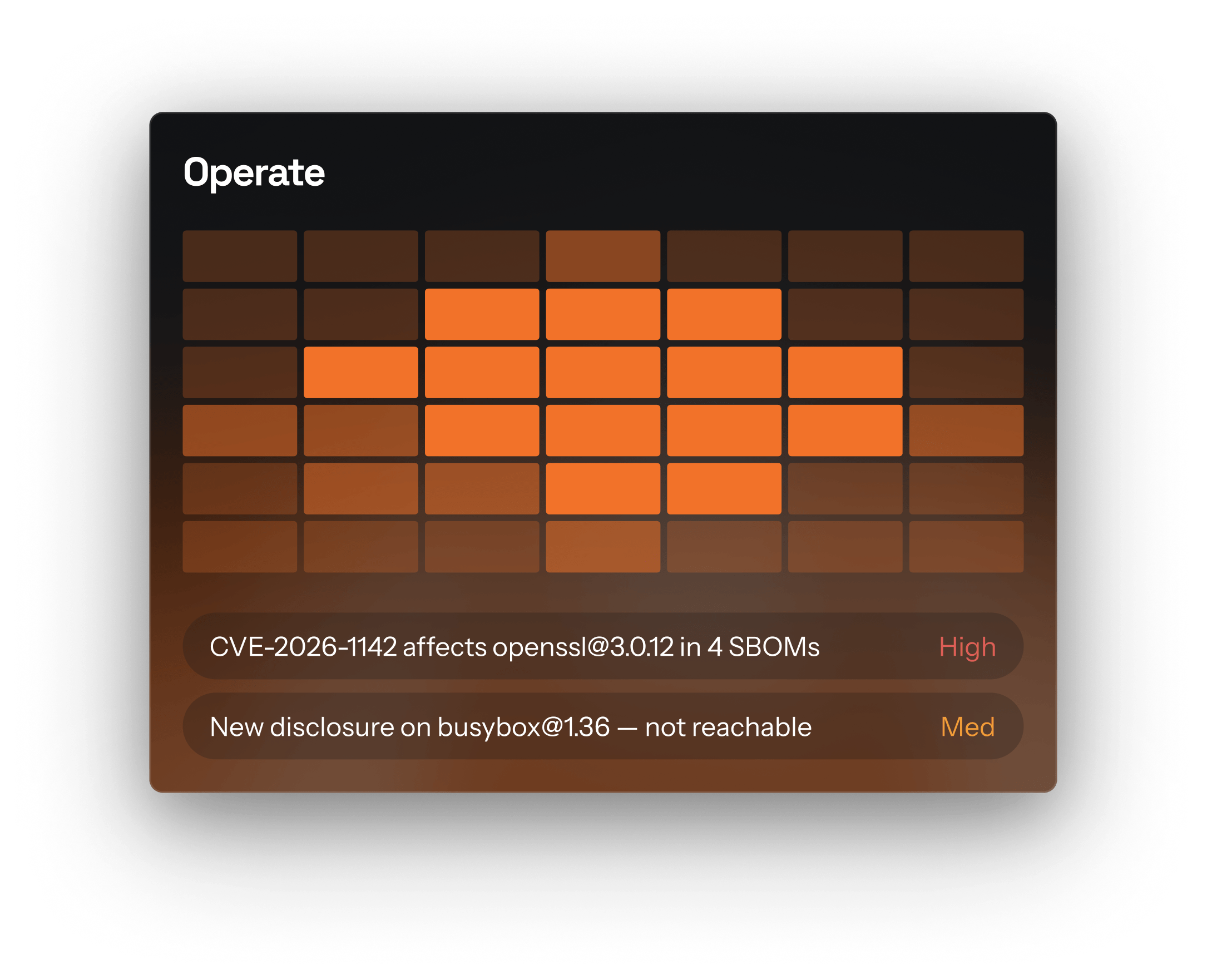
Keep evidence current as products, vulnerabilities, and compliance requirements change.


Finite State embeds security and compliance directly into the release workflow.
That means less manual work, faster decisions, and proof that stays current.
What Fragmented Tools Miss
Most teams use separate tools for source code, firmware, vulnerability analysis, CI/CD, and compliance evidence. Each tool sees part of the product. Finite State connects the signals across shipped software, design context, risk, and proof.
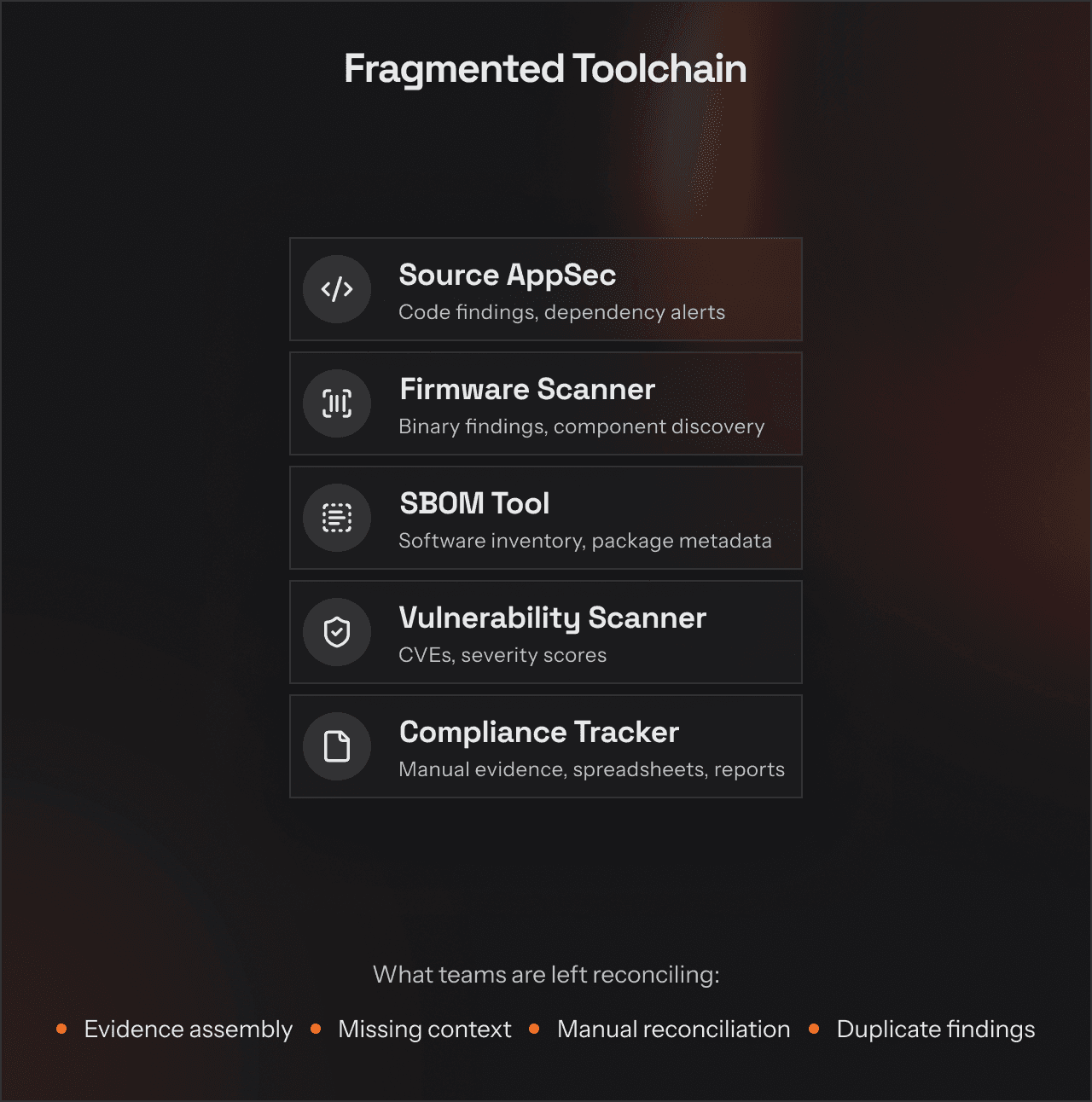 Fragmented Toolchain. Source AppSec: Code findings, dependency alerts. Firmware Scanner: Binary findings, component discovery. SBOM Tool: Software inventory, package metadata. Vulnerability Scanner: CVEs, severity scores. Compliance Tracker: Manual evidence, spreadsheets, reports. What teams are left reconciling:. Duplicate findings. Manual reconciliation. Missing context. Evidence assembly
Unified Product Security vs Fragmented Toolchains
| FeatureFeature |   | Typical AppSec (source-only)Typical | Firmware-Only ScannersFirmware-Only |
|---|---|---|---|
Unified source and binary analysisUnified source and binary analysis | |||
Binary and firmware decompositionBinary and firmware decomposition | |||
SBOM generation and merge (source + binaries)SBOM generation and merge (source + binaries) | |||
Deduplication and correlation across buildsDeduplication and correlation across builds | |||
Reachability-based vulnerability analysisReachability-based vulnerability analysis | |||
Multi-source exploit intelligence enrichmentMulti-source exploit intelligence enrichment | |||
Policy checks and CI/CD gatesPolicy checks and CI/CD gates | |||
Audit-ready evidence packs (CRA, FDA, and others)Audit-ready evidence packs (CRA, FDA, and others) | |||
Post-market monitoring with living SBOMsPost-market monitoring with living SBOMs | |||
Developer workflows with PR-ready diffsDeveloper workflows with PR-ready diffs |
Built for the Workflows Teams Already Use
Finite State connects product security workflows to the tools engineering teams already use across CI/CD, cloud infrastructure, ticketing, development, and compliance operations. Teams can analyze complex firmware, binaries, and source code while embedding reviewable security checks directly into existing release workflows. Works with existing CI/CD, developer, cloud, and compliance workflows—without requiring teams to replace the tools they already depend on.

Vulnerability and Exploit Intelligence Sources
Enrich findings with broader risk and threat context.
Product software includes firmware, binaries, source, and CI/CD pipelines. Finite State analyzes software, adds vulnerability intelligence, and links security workflows to existing tools, embedding checks without slowing delivery.
Integrations
Connect product security workflows across DevSecOps tools and CI/CD.

Reachability-Driven Noise Reduction
Focus triage on vulnerabilities that matter to the shipped product.
Broad Source, Binary, and Firmware Coverage
Analyze complex product inputs and compiled components.
Integrate with the tools you love
Security findings, risk decisions, and compliance evidence stay synchronized across developer, security, and compliance workflows.
Integrate with the tools you love
Security findings, risk decisions, and compliance evidence stay synchronized across developer, security, and compliance workflows.
CI/CD + Release Pipelines
Embed product security checks directly into GitHub Actions, GitLab CI, Jenkins, and existing release workflows.
Developer + Engineering Workflows
Use APIs, CLI tooling, IDE integrations, and ticketing workflows that fit naturally into day-to-day engineering operations.
Automation + Platform Extensibility
Build custom integrations, policy automation, and workflow orchestration using REST and GraphQL APIs.
Policy + Governance Workflows
Define security policies as code, version them alongside applications, and enforce reviewable controls automatically during builds and releases.
See the Real Exposure on Your Product
Bring a build (and supplier SBOMs, if available). We’ll show how it becomes audit-ready proof.